1Learning Outcomes
Translate C loops into RISC-V assembly instructions.
See a
forloop in assembly.
🎥 Lecture Video
8:50 onwards
We’ll cover the for loop implementation in detail below, then leave the other loops for you to reference later.
2C code
The below C loop adds up 20 integers in an array arr and stores the result in sum.
1 2 3 4 5 6 7int arr[20]; ... // fill arr with data int sum = 0; for (int i=0; i<20; i++) { sum += arr[i]; } // ...
Implementing loops in assembly is similar to writing loops with goto syntax. Click to show how we can rewrite the loop above with goto and labels.
Click to show goto loop
goto loop1 2 3 4 5 6 7 8 9int arr[20]; … int sum = 0; int i = 0; Loop: if(i >= 20) goto End sum += arr[i]; i++; goto Loop End: // …
3RISC-V translation
Here is the full assembly translation of the original C code.
    add   x9  x8  x0
    add  x10  x0  x0
    add  x11  x0  x0
    addi x13  x0  20
Loop:
    bge  x11 x13 End
    lw   x12  0(x9)
    add  x10 x10 x12
    addi  x9  x9   4
    addi x11 x11   1
    j Loop
End:
...3.1Register Assignments
Show Answer
Reference the assembly above as you go through the answers.
Register
x8holds&arr[0], the address of the first element of thearr(equivalently, the address ofarr).Register
x11holdsi, the loop variable. Hints are from theadd x11 x0 x0instruction right before theLoop, and theaddi x11 x11 1instruction before we jump back to the start of theLoop.Register
x9holds&arr[i], the address of the current element of thearr. Hints are from the first instructionadd x9 x8 x0and the integer pointer arithmetic instructionadd x9 x9 4before we jump back to the start of theLoop.Register
x12holdsarr[i], the current element ofarr(the value, not the address). Hints are from its initialization withadd x10 x0 x0and its use within the loop,add x10 x10 x12.Register
x10holdssum, the current value ofsum. The hint is the singularadd x10 x10 x12instruction in theLoop.Register
x13has the immediate value20and it is set inaddi x13 x0 20. This value is used in thebgebranch instruction, which must compare registers.
3.2Line-by-Line
The assembly again, now commented. Hover to reference the original C code.
1 2 3 4 5 6 7 8 9 10 11 12 13add x9 x8 x0 # &arr[0] add x10 x0 x0 # sum = 0 add x11 x0 x0 # i=0 addi x13 x0 20 Loop: bge x11 x13 End # if i >= 20, then branch lw x12 0(x9) add x10 x10 x12 # sum += arr[i] addi x9 x9 4 # &arr[i+1] addi x11 x11 1 # i++ j Loop End: ...
Line 1. add x9 x8 x0. Put the first (zero-th) element in register x9.
Line 2. add x10 x0 x0. Initialize the sum to zero in register x10.
Line 3: add x11 x0 x0. Initialize the loop variable i to zero in register x11.
Line 4: addi x13 x0 20 (li x13 20). Put the value 20 in register x13 to use for the branch instruction.
Line 5-6: bge x11 x13 End. If the current loop variable is greater than or equal to zero, branch to the End instruction in Line 13.
bgeexits loop ifR[x11] >= R[x13]is true.Otherwise if false, then
i < 20, so continue in the loop.Note that the labels
LoopandEndare not instructions; rather, they are bound to instruction addresses (i.e.,Loopis the address of thebgeinstruction).
Line 7: lw x12 0(x9). Get the value of arr[i] and put it in register x12.
Line 8: add x10 x10 x12. Add arr[i] to the current sum in register x10; write the result back to register x10.
Line 9: addi x9 x9 4. Get the address of the next element, &arr[i+1]. Update the byte address in register x9 by adding 4 (sizeof(int) is 4).
Line 10: addi x11 x11 1. Increment i by one. This is needed for the branch instruction comparison.
Line 11: j Loop Jump to the branch instruction.
Line 12: If we reached this instruction, we have exited the loop.
3.3Run Demo
You can run the below demo in a RISC-V simulator like Venus.
arr20.s
arr20.s.data
output: .word 1, 2, 3, 4, 5, 6, 7, 8, 9, 10, 11, 12, 13, 14, 15, 16, 17, 18, 19, 20
.text
# `output` is a pointer to an int array
# set x8 to `output`
la x8 output
add x9 x8 x0
add x10 x0 x0
add x11 x0 x0
addi x13 x0 20
Loop:
bge x11 x13 End
lw x12 0(x9)
add x10 x10 x12
addi x9 x9 4
addi x11 x11 1
j Loop
End:
mv a0 x10
jal print_int
# passing 10 to ecall will terminate the program
li a0 10
ecall
# prints out one integer
# input values: a0: the integer to print
# does not return anything
print_int:
# to print an integer, we need to make an ecall with a0 set to 1
# the thing that will be printed is stored in register a1
# this line copies the integer to be printed into a1
mv a1 a0
# set register a0 to 1 so that the ecall will print
li a0 1
# print the integer
ecall
# return to the calling function
jr ra4Control Structure Reductions
We describe “go-to” (heh) ways of reducing common loops to structures that are more directly translatable into assembly.
4.1if conditional
Consider the below C code. The code reduction uses the idea leveraged in Example 1 and Example 2 to flip the conditional with a goto statement.
if(cond) {
    line1;
    line2;
}
line3;
Show Reduction
if(!cond) goto AfterIf;
line1;
line2;

AfterIf:
line3;4.2while loop
while(cond) {
    line1;
    line2;
}
line3;
Show Reduction
Loop:
    if(!cond) goto AfterLoop;
    line1;
    line2;
    goto Loop;

AfterLoop:
line3;4.3while loop with break
In the below code, break reduces to a goto statement:
while(true) {
    line;
    break;
}
line;
Show Translation
while(true) {
    line;
    goto AfterWhile;
}
AfterWhile:
line;4.4for loop
for(startline;cond;incline) {
    line1;
    line2;
}
line3;
We recommend first translating for loops into the equivalent while loop:
startline;
while(cond) {
    line1;
    line2;
    incline;
}
line3;
Finally, reduce with goto.
Show Reduction
startline;

Loop:
    if(!cond) goto AfterLoop
    line1;
    line2;
    incline;
    goto Loop

AfterLoop:
line3;4.5do-while loop
The C code:
do {
    line1;
    line2;
} while(cond)
line3;
Show Reduction
Loop:
    line1;
    line2;
    if(cond) goto Loop;

line3;5Appendix: goto
In C, the goto Label; statement sets the next line to execute to be the line labeled with Label. This labeled line can be anywhere else in the program.
Figure 2 gives us one humorous (if not fictional) reason why we should not use goto in C programming.
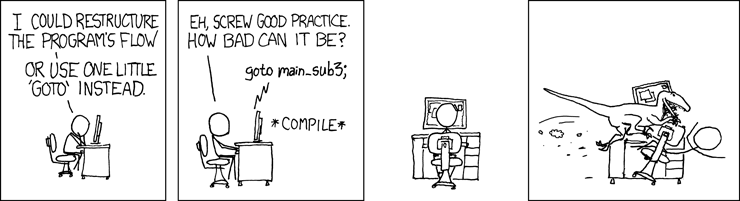
Figure 2:Using goto could lead to velociraptor attacks. (xkcd, explainxkcd)
Nevertheless, we share a few goto examples in C, for those of you who want more practice writing code more amicable to direct assembly translation. We encourage you to take these examples with a grain of salt.
5.1malloc example
Consider the below code. We would like to rewrite this code in case any malloc call fails and returns NULL.
int* a = malloc(sizeof(int)*1000);
int* b = malloc(sizeof(int)*1000000);
int* c = malloc(sizeof(int)*1000000000);
FILE* d = fopen(filename);
The below code is one attempt, though it fails to free previous malloc blocks.
int* a = malloc(sizeof(int)*1000);
if(a == NULL) allocation_failed();
int* b = malloc(sizeof(int)*1000000);
if(b == NULL) allocation_failed();
int* c = malloc(sizeof(int)*1000000000);
if(c == NULL) allocation_failed();
FILE* d = fopen(filename);
if(d == NULL) allocation_failed();
The final code uses goto to free previously allocated blocks upon any single failure.
int* a = malloc(sizeof(int)*1000);
if(a == NULL) goto ErrorA;
int* b = malloc(sizeof(int)*1000000);
if(b == NULL) goto ErrorB;
int* c = malloc(sizeof(int)*1000000000);
if(c == NULL) goto ErrorC;
FILE* d = fopen(filename);
if(d == NULL) {
           free(c);
ErrorC:    free(b);
ErrorB:    free(a);
ErrorA:    allocation_failed();
}